
Our Approach

Innovative Technology. Oncology Focus.
Our Technology
CorriXR Therapeutics has engineered a proprietary CRISPR/Cas biomolecular tool to knock out NRF2, a key transcription factor that drives tumor survival and resistance pathways. By disrupting this pathway, we aim to reprogram the tumor microenvironment, disable resistance mechanisms, and restore sensitivity to standard of care (SOC) treatments.
This approach has multiple applications:
Neoadjuvant setting: Shrink tumors prior to surgery, optimizing tissue and organ preservation.
Pre-SOC treatment: Administer CXR101 prior to SOC (chemotherapy, radiotherapy, immunotherapy), to sensitize tumor cells to treatment, potentially enabling more patients to be eligible for therapy, and at lower doses with higher treatment completion rates.
Our first genetic target is NRF2, a master transcriptional regulator that functions to activate genes in response to cellular stress. While essential for normal cell function, NRF2 becomes oncogenic when upregulated, creating a pro-carcinogenic microenvironment around tumor cells and driving therapy resistance.
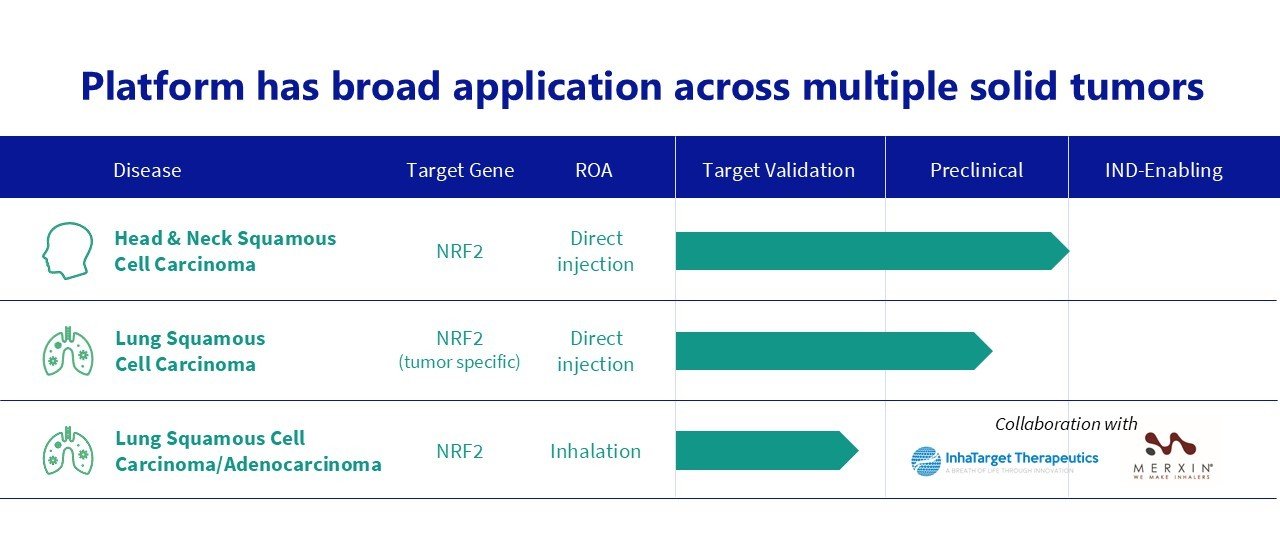
Our proprietary CRISPR-directed approach selectively disables NRF2 gene functions in cancer cells. Our preclinical data in both cell and animal models confirms that the NRF2 gene is a viable target for a gene editing-based therapeutic for solid tumors.
To deliver this innovation with precision, we use a proven lipid nanoparticle (LNP) system combined with a localized administration approach to ensure direct engagement at the tumor site and minimal off-target effects.

Novel Oncology Target for Gene Editing:
NRF2 Pathway
Global regulator of stress response: NRF2 protein is a global transcriptional regulator that functions to activate genes in response to cellular stress. NRF2 maintains homeostasis in terms of normal cell behavior but can also act as an oncogene and help tumor development.
Mutational activation: Upregulation of the KEAP1/NRF2 pathway is observed in several tumor types, notably squamous cell lung cancer, and is associated with therapy resistance.
Preclinical efficacy: In Head and Neck Squamous Cell Carcinoma (HNSCC) and squamous Non-Small Cell Lung Cancer (NSCLC) in vitro and in vivo studies, our data show that disabling NRF2 leads to tumor cell death and shrinkage in combination with chemotherapy drugs.
CorriXR Development Pipeline

Contact Us
Reach out to discuss partnerships to advance our technology.